
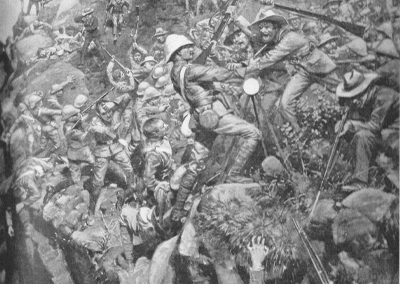
Once the guerrilla phase of the Anglo-Boer War had started, significant military action took place in the Magaliesberg mountains. On 13 December 1900, on the farm Nooitgedacht, 1 500 British soldiers under the command of Major General Clements, were encamped. Before dawn 2 500 Boers under Generals de la Rey, Smuts & Beyers attacked the camp, Beyers from the top of the Magaliesberg and de la Rey from the base.
De la Rey had scouted Clements’ camp for three days. The camp had a good water supply and the nearby mountain allowed communication by heliograph with Pretoria and Rustenburg, both major British command headquarters. However, the campsite was dominated in the north by this 300-metre high mountain. 1 500 burghers led by General Beyers arrived in the area on 12 December, and together with de la Rey’s commandos the Boers had numerical superiority over their adversaries.
Smuts later wrote of Clements’ camp siting, “I do not think it was possible to have selected a more fatal spot for a camp.”
On 13 December 2019, 119 years later, a Blue Plaque ceremony was held near Nooitgedacht to commemorate this battle. A blue plaque is a permanent sign installed in a public place to commemorate a link between a location and a famous person or event, serving as a historical marker. Such sites are thoroughly investigated before permission is granted to install a plaque. Several such plaques have been installed at historical battle sites in the Magaliesberg area, and Battle Tours ZA will be visiting these sites.
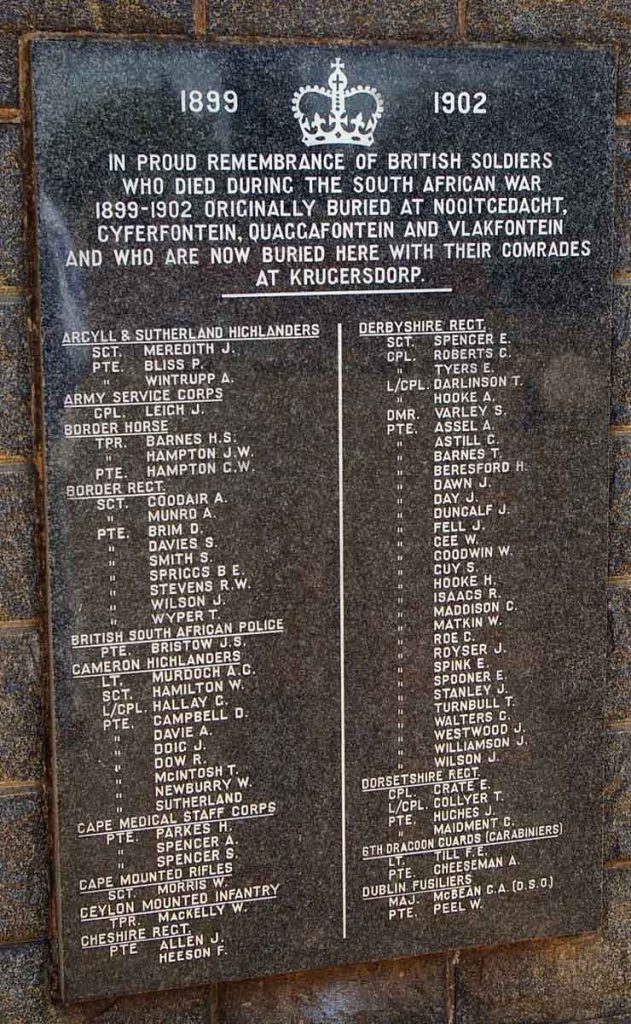
The world’s first blue plaques were erected in London, Great Britain in the nineteenth century to mark the homes and workplaces of famous people.
